

Did the California Goldrush Save the Whales from Extinction?
Whaling has a certain romantic lore in American culture. Much like the mountain men, whalers were taking advantage of a seemingly prolific natural resource and making vast
fortunes from it. In the 21st century, we can look back on both industries with scorn, knowing how close the beavers and whales were pushed to extinction by human greed.
While creating my stories, I have found the examination of what happened as it relates to what we know now so very interesting. And here is the question we can ask, did the California goldrush play a role in saving whales from extinction?
Because whaling plays a bit role in Kismet, I also want to explore a little about life on a whaling vessel in the mid-19th century. Let’s start with some background.
Native Americans were hunting whales when the Europeans arrived in the 1600s. Known as “shore whaling,” the whale was hunted in specialized canoes using harpoons tipped with shell or bone, fatigued with sealskin floats until it could be killed and hauled to the shore. It is there that members of the tribe would begin to disassemble the carcass and use every bit of the animal.
Nantucket, Massachusetts was at the center of shore whaling, although shore whaling was practiced up and down the East Coast. The practice went on until early in the 1700s when the first sperm whale is killed and “deep ocean” whaling begins. Nantucketers specialized in deep ocean whaling for the next century and a half.
To accomplish deep ocean whaling, ships had to be outfitted with onboard tryworks – brick furnaces that rendered the whale’s blubber into oil. This processing allowed whaling ships to travel greater distances for longer durations and increase their profitability.
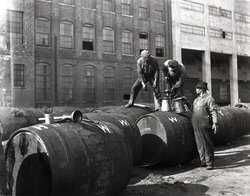
Let’s take a look at what it took to process the whale blubber into oil. There are many, many steps that had to go right for the crew to even bring a whale alongside the ship but, for my story, it’s what happens next that counts.
Once the dead whale is brought alongside the ship, the men erected a wooden platform called the “cutting stage” above the floating carcass and the ever-present sharks drawn by the bloody water. With long knives attached to poles called cutting spades, the men stripped off the thick, outermost layer of fat known as blubber. Each strip could weigh as much as a ton. From there, they cut the strips into smaller, more manageable pieces and hurled them to the deck. The pieces of blubber were boiled down into oil in enormous iron pots, called try pots, sitting on the brick tryworks. Once the blubber melted into oil, it was put into casks and stored in the cargo space below decks.
But a lot could happen in this process that made it a very dangerous job. The deck became slick with blood and oil so if a man wasn’t careful, he could slip overboard where sharks were feasting on the whale carcass. Sometimes the huge chunks of blubber being thrown on deck would crush an unsuspecting crew member. Fatal cuts from the cutting spades happened. And, boiling oil was a scalding risk, especially in rough seas.
Now that we understand the process, let’s look at historical events. There are some historians who posit that a rare combination of events happened in the 1850s that shifted the Americans’ use of whale oil. The first, and most important to my stories, is when gold fever hit the whaling ships working in the Pacific first, and then eventually all over the world. Imagine having been gone for three years sailing the wide ocean hunting whales. Imagine living with the stench when it was commonly known that a downwind ship could smell a whaling ship before seeing it. And imagine the lure of easy wealth after working at this kind of job and the daily dangers of it. Picking up gold by the handfuls seems like a better deal, right?
There are accounts of men who mutinied their ship to sail to California. Some abandoned their captain while in port and found a California bound ship to sail on, leaving all their accumulated wages, in the form of oil stored in casks, for the dream of gold. Many a whaler rotted in the bay of San Francisco when the crew took off for the goldfields.
The “Golden Age” of American whaling hit its peak in 1853 when the sale of whale products totaled $11 million. As the decade worn on, whale populations declined, and whalers had to be gone for longer durations to accumulate a profitable cargo. And then petroleum was discovered in Pennsylvania in 1859. The smokey, smelly, and expensive whale oil was replaced with the cleaner burning, cheaper and easier to obtain, kerosine for the illuminant market.
In the 1860s, twenty-four of New Bedford’s whaling ships were purchased by the Union forces, sailed to Charleston, South Carolina and sunk to form blockades against Confederate forces in harbors. In the decades following the Civil War, whaling’s economic role only diminished further.
As one of America’s first great industries, whaling played an enormous role in wealth accumulation as well as the romanticizing of the grand adventure of whaling. Fortunately for the whales, these series of events in the mid 19th century, along with conservation efforts in the 1970s, have led to the species being protected unless for scientific research.
I just finished listening to a three-part Freakonomics podcast (Episodes 549,550, and 551) about the history, economics, and environmental impacts of whaling. If you are interested in whaling, I encourage you to listen to these podcast episodes as they are very informative.
I used the following resources for writing this blog: Pbs.org: “American Experience”, The History of Whaling in America” Timeline and NPS.gov: “The Whale Hunt”, New Bedford Whaling National Historical Park


Comments